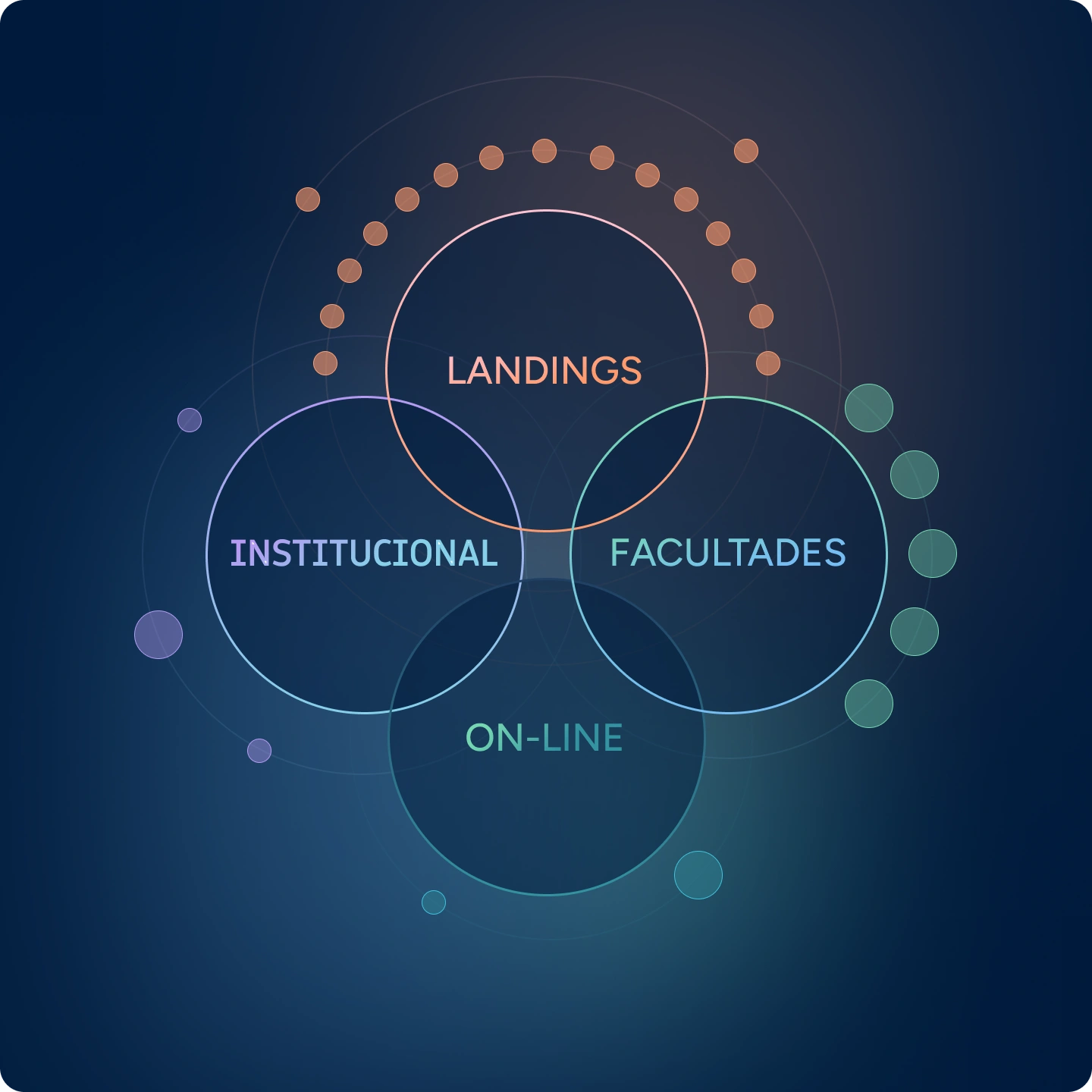
Centralize Without Suffocating: Governance as a Brand Advantage in Multi-Faculty Universities
Control and fast publishing shouldn't compete. Separating who decides the system from who publishes within it resolves the CIO, CMO and comms tension.


Key Takeaways
- The false dilemma: control, speed and editorial autonomy don't have to compete if the system separates who decides the design from who publishes the content.
- Three roles, three brakes: the CIO, CMO and institutional communications team protect different needs that collide on most platforms — never the people's fault, always the system's.
- One system, three winners: the Embedded Design System and granular RBAC let all three win at once, as shown by Universidad Pontificia Comillas: 60 people, 31 departments, one single instance.
The false dilemma
Control and fast publishing shouldn’t compete with each other. At most universities, they do.
The CIO locks down access to protect the infrastructure. The CMO needs to launch the admissions campaign now. The institutional communications team —spread across faculties, campuses and centers— has a story that can’t wait its turn. All three are right. And on most platforms, all three get in each other’s way.
The usual answer is to pick a side. Centralize everything and slow institutional communications to a crawl. Or decentralize everything and watch the brand fragment the moment thirty departments start publishing on their own. Neither comes free. And neither is necessary if the system draws a clean line between what needs to be centralized and what needs to stay free.
There’s more than operations at stake here: the institutional reputation of the entire university. Every misaligned site, every approval that takes weeks, is a signal to the outside world that no one is governing the whole.
Three roles, three brakes
Each role protects something different, and that something collides with what the other two need.
The CIO answers for the security and stability of the system. Every new permission is a door someone, someday, might leave open. Their instinct: restrict access and audit everything possible.
The CMO answers for enrollment. They need to launch landing pages, update programs and adjust messaging at the market’s pace —not a development ticket’s pace— and have the brand hold up under that pace without cracking.
Communications leadership, often a Vice-Rector for Communications, answers for institutional current affairs. They run a team of journalists spread across campuses and faculties: research, campus life, news that can’t wait for Marketing to free up calendar space or for the development team —internal or external— to clear a pending request.
On most platforms, giving one of the three more autonomy means taking control away from the other two. That’s why governance usually ends up as a technical problem solved alone by whoever has access to the code —the development team, internal or external— instead of a brand decision that supports all three roles at once. None of the three is wrong. It’s the system they use that forces them to compete.
Griddo’s model: separating the “how” from the “what”
Griddo separates two questions that most platforms confuse: who decides the system —design, permissions, brand structure— and who publishes within it —the content, the day-to-day editorial work.
The Embedded Design System locks down what should never change: colors, typography, components, brand structure. It acts as a technical barrier that stops an editor from breaking code, while protecting visual identity at the same time. Every published page respects the university’s brand, whoever signs off on it: the result comes out already approved by design.
On top of that base, the roles and permissions system (RBAC) defines, by site, by section, by page and even by language, who can edit, review or publish each piece. Multi-level approval flows let each team work at its own pace, with central control intact. At Universidad Pontificia Comillas, 60 people from 31 departments, faculties, institutes and chairs —Library, Alumni, ICAI, ICADE, International Relations, the Refugee Program, among others— publish on a single instance, with centralized governance intact. Every publication is logged with its author, its site and its date, ready to roll back to any earlier version with production always kept safe.
The result, measured on the platform itself: 5 times less onboarding time for a new editor and 73% fewer unauthorized content changes. At Universidad Europea, two organizations —the university itself and Centro de Estudios Garrigues— coexist on a single instance with differentiated permissions, each publishing its own program catalog within clearly defined limits. At IE University, three digital agency profiles coexist with seventeen internal accounts on the same instance: the agency runs the catalog and publishing volume, the internal team runs modules, page architecture and images. Neither blocks the other, and neither needs to go through IT to do their part.
As Lucía Tornero, from Communications at Universidad Pontificia Comillas, sums it up: “Griddo has given us a level of consistency we’d never achieved before. Every page already carries Comillas’s voice: consistent, recognizable, ours.”
The same system also supports regulatory compliance alongside the brand: SSO access (SAML, LDAP, Active Directory), compliance built in by design, and an audit log covering 100% of actions on the platform. When the rector’s office or legal asks who published what, governance already has the documented answer.
We’ve already covered how this same architecture redraws a university’s security perimeter. Here the focus is on what that perimeter enables: real autonomy for three roles that, on most platforms, compete for the same control.
What happens without this model
The pattern is a familiar one. It starts with a faculty that can’t wait weeks for the development team to make room, so it stands up its own site. Another follows. Within a couple of years, the university has dozens of sites —sometimes hundreds— with different templates, different typography, and a tone that shifts from faculty to faculty. Each one is, from the inside, a small victory for autonomy. From the outside, it’s a fragmented brand that a student or a journalist notices within two clicks.
We’ve already covered this in detail in the autonomy paradox: fifty sites and no ecosystem. And also in building a cohesive vision for the university web ecosystem. It’s the same problem, seen now from governance instead of infrastructure. The emergency fix is usually to recentralize everything at once: the faculty that had autonomy loses it, and the team that had gained speed goes back to depending on the development request queue. The pendulum doesn’t resolve the tension between the three roles: it just changes who’s complaining this time.
Start with your role
Each of the three roles needs something different from governance, and each has to make the case to the other two. That’s why this Hub opens into six guides, one per profile:
If you’re a CIO, start here → Reducing shadow IT, granular RBAC by site and section, the Design System as a technical barrier —and how to explain to Marketing and Communications that this same control is what lets them move fast.
If you’re a CMO, start here → Why well-designed governance accelerates campaign launches instead of slowing them down, and how to keep the brand consistent across every faculty feeding the Admissions funnel.
If you lead Communications, start here → Publishing speed for a team distributed across campuses, with institutional consistency guaranteed and automatic visibility into what each one publishes.
If you’re the President or Rector, start here → Web governance as a reputational asset —or risk— and how to stop arbitrating between IT, Marketing and Communications case by case.
If you’re the Brand Manager, start here → Why the Embedded Design System turns the brand guidelines into a system that enforces itself, instead of a PDF nobody follows.
If you lead Digital Transformation, start here → The complete business case: how to present it to each department head, anticipate internal resistance and sequence the conversation.
Your next step
If you recognize this tension between control, speed and editorial autonomy at your own university, let’s talk about how to separate these three needs instead of sacrificing one for the other two.
This article opens Griddo’s Governance cluster on the Journal. The whitepaper “Digital Governance as a Competitive Advantage in Higher Education” publishes in the coming days.