Your University's Web Ecosystem: Building a Cohesive Vision with Griddo
What a university web ecosystem is, why it matters now, and how Griddo, the DXP for universities, builds it centrally for a coherent brand.

Key Points
- Strategic Coordination: A university web ecosystem aims not for rigid control but for strategic coordination across technology, communications, governance, and brand to eliminate fragmentation.
- AI-Ready Content Hub: The rise of zero-click searches and LLM adoption makes a centralized, structured content ecosystem essential for university visibility in the new era of search.
- Unified Platform Advantage: Griddo manages the entire web ecosystem from a single DXP, from flagship marketing sites to niche program pages, delivering an unbeatable total cost of ownership.
University digital channels have become the epicenter of connection with students, faculty, researchers, administrative staff, and even suppliers. University websites have been growing and evolving for years to adapt to the new reality, but that growth inevitably brings complexity.
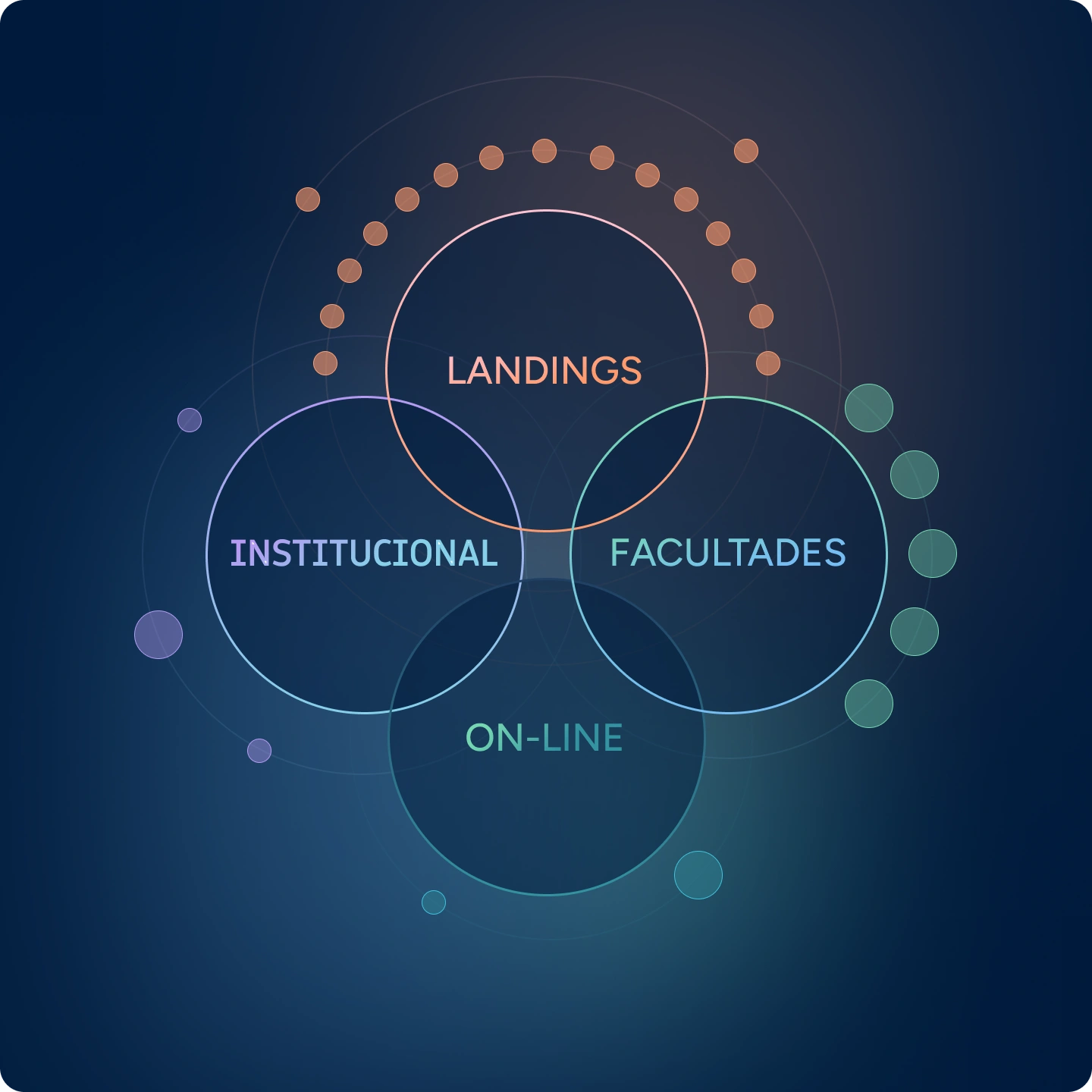
We are firsthand witnesses to the phenomenal increase in needs experienced by university marketing and communications teams. Practically all universities manage an expanding structure of different websites. Each of these instances has been created for specific needs, different audiences, and very different business objectives. This independence can foster innovation and agility on a small scale, but inevitably leads to a fragmented experience for both users and internal teams. It’s like an orchestra where each musician plays their own melody.
This common situation must be approached by taking perspective and facing the challenge as an opportunity to generate an ecosystem with formidable potential.
With a unified and centralized web ecosystem approach, institutions have the opportunity to align their digital assets to amplify the impact of their mission. But just as fragmentation tends to create major inefficiencies, centralization introduces the risk of blockage, if not implemented with the necessary flexibility for work to be distributed among different internal teams. Ultimately, the new system must enable collaboration, increase efficiency, and ensure a cohesive, high-quality digital presence that supports the institution’s complete mission. The goal is not rigid control, but strategic coordination.
What is a University Web Ecosystem?
A university web ecosystem functions as an interdependent network of platforms, channels, and teams that, ideally, collaborate through information and resource exchange.
Marketing, communications, and admissions teams often operate independently of each other. The separation from research teams is even greater, in general. However, they share many objectives and, generally, all limitations. Implementing a web ecosystem model helps align resources through a collaborative and strategic approach, resulting in a more sustainable, more effective, and much more productive system.
It’s crucial to understand that a university web ecosystem is not a monolithic, single structure. It’s an interdependent system of websites, infrastructure, and governance that requires coordinated decision-making across:
- Technology: Platforms, architecture, hosting
- Communication Strategy: Marketing, content, publishing.
- Web Governance: Policies and responsibilities.
- Brand: Prestige, consistency, and coherence
Now is the Time to Invest in a Web Ecosystem
The current market situation is ideal for migrating to a web ecosystem. The significant revolution we’re immersed in as we advance in the new era of Artificial Intelligence is full of risks and opportunities that make this migration strategically transcendent for universities. To properly evaluate the decision, it’s necessary to reflect on the forces changing the market:
- User Experience: Today’s users, across all age ranges, are accustomed to simple, high-quality usage experiences, both for websites and mobile. Their expectations regarding ease of use and consistent experiences are therefore very high. A web ecosystem approach allows ensuring consistent UX across digital touchpoints, and adapting more easily to new online patterns through iterative improvements.
- Accessibility: Web content and technologies that don’t comply with new accessibility regulations face strong legal consequences for institutions. Without solid governance and support to ensure accessibility compliance, the risk of non-compliance skyrockets. The web ecosystem approach helps identify and address these issues.
- Limited Budgets: The budget and resource pressure institutions suffer is enormous, yet it’s increasingly essential to communicate through more channels. By managing systems collaboratively, as part of an ecosystem, efficiencies are leveraged and the very costly sunken structure of a disintegrated system is reduced.
- Artificial Intelligence at the Service of Your Team and Users: Griddo’s modern architecture allows connecting to AI services and integrating them into workflows to improve ecosystem efficiency and maintainability. Additionally, having all content structured and centralized enables new exploitable capabilities through Artificial Intelligence.
- Ready for New Search Models and AI: The explosion in LLM adoption is redefining how content is searched and consumed. Zero-click searches are already being discussed, which is very descriptive of the phenomenon. These tools are tremendously useful, but only if sources are reliable, information is correct, up-to-date, and all content is properly organized. AI makes publishing organized, accurate, and useful content even more necessary. It’s necessary to reconsider content structure and taxonomy, as well as its quality and relevance. A connected content strategy is necessary.
The web ecosystem must become a canonical content hub to be the discovery platform for University AIs.
How to Build a University Web Ecosystem with Griddo
When considering a project of the magnitude involved in changing an entire university’s web ecosystem, you need an appropriate plan and trusted partners with proven experience. Griddo is designed to be the platform that not only understands, but solves the challenges of building, implementing, and maintaining a cohesive and effective university web ecosystem, which is why it’s the platform adopted by the most prestigious universities.
A university web ecosystem building program can be approached in different ways; it’s important to consider the institution’s objectives.
Big Bang
The big bang program is initially undertaken by changing the websites that will have the most impact on achieving the university’s main objectives: increasing enrollment, improving brand perception, and modernizing the digital experience.
In this case, it will be very important to do a deep analysis phase, which allows extracting maximum benefit from creating the web ecosystem:
- Centralizing core content to improve efficiency and facilitate its use: Academic offering and regulatory content (academic programs, faculty profiles, institutional news) must be structured and centrally managed for reuse. Griddo allows unifying it, either by managing it directly or by integrating with sources. And since Griddo enables multi-site management, content can be reused, ensuring:
- Consistency: Accurate information wherever the user accesses it.
- Efficiency: Centralized updates, change once, deploy across all data instances. Time savings and error reduction are enormous.
- Optimized UX: A simpler and smoother user experience among the managers of different websites, with consequent time savings and improved security.
- Investment in shared assets: tools and systems transversal to different departments and functions (analytics, personalization, search, DAM) should be centrally managed. Griddo, as a DXP, integrates with these tools, reducing the need for multiple subscriptions and improving data integration.
Pilot Project
The pilot project approach starts by tackling websites that have become technologically obsolete, but are important for covering internal services, to students, or for institutional or research communication. In general, this approach seeks to manage risk.
Priority Structure
Either way, it’s important to catalog the university’s different sites into three segments according to their criticality and business impact. A common approach to this categorization is:
- Primary Marketing Sites: Fully leverage all Griddo functionalities for the highest standards.
- Key Outward-Facing Sites: Share Griddo’s design system and components, maintaining flexibility within a unified brand framework.
- Non-Strategic or Internal Sites: Reuse Griddo’s most common modules for basic publishing needs with minimal maintenance.
This ability to serve all levels from a single DXP is a powerful simplification that only Griddo can offer with its architecture.
Unlike the common approach of using different CMS for different site levels, Griddo allows managing your entire web ecosystem, from the institution’s main page to niche program pages, from a single platform. The direct consequence is that the “Total Cost of Ownership” of a centralized and well-managed solution like Griddo is unbeatable.
As if this weren’t enough, Griddo is a future-ready platform that helps you transition from other outdated systems, which is critical from a strategic standpoint.
Griddo: Your Ally in Building the University Web Ecosystem of the Future
Higher education institutions suffer from the complexity of an environment experiencing exponentially accelerated changes in the digital landscape. The web ecosystem approach establishes a strategic framework and a solid foundation to bring clarity, efficiency, and coordination.
The combination of centralized control of brand image and governance model, along with the flexibility to create content distributed across the institution is finally available. Technology based on flexible and scalable systems that allow your teams to do their best work, offering a superior experience to your audiences is here.
Griddo not only provides you with this strategic platform, but offers you the tools and architecture (no-code, MACH, AI-powered, with its own design system adapted to your brand) to build a robust, efficient, and cohesive university web ecosystem. It’s the key to transforming fragmentation into a competitive advantage and ensuring your institution thrives in the New Era of Search.